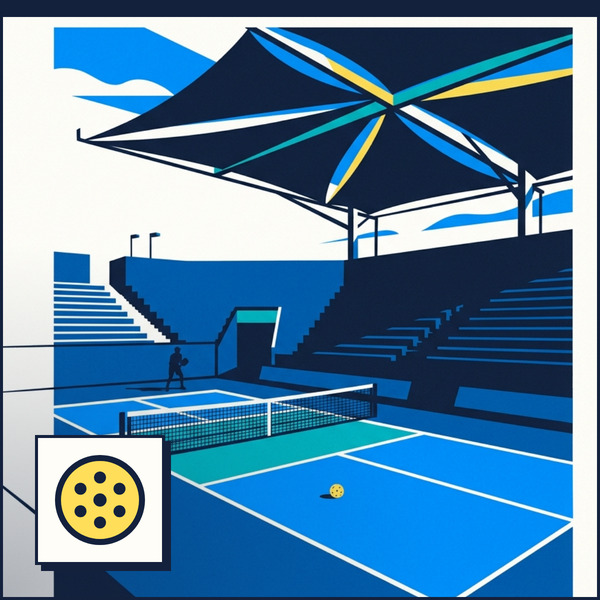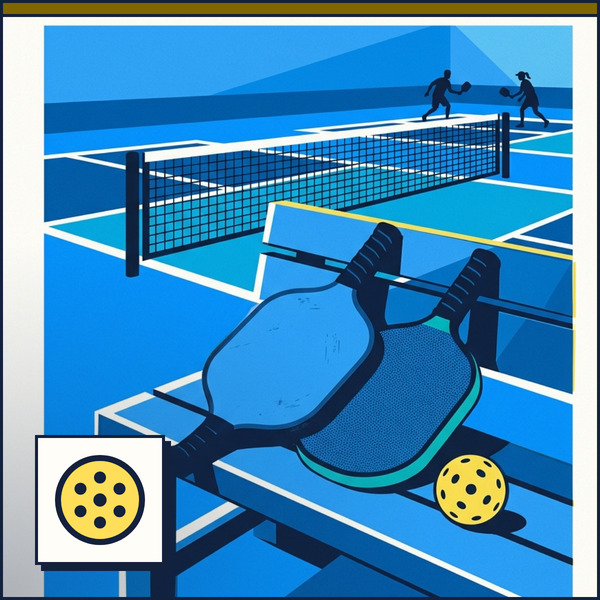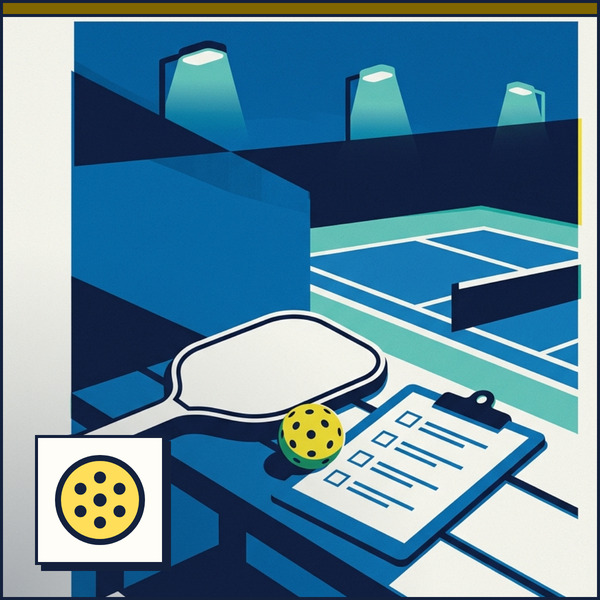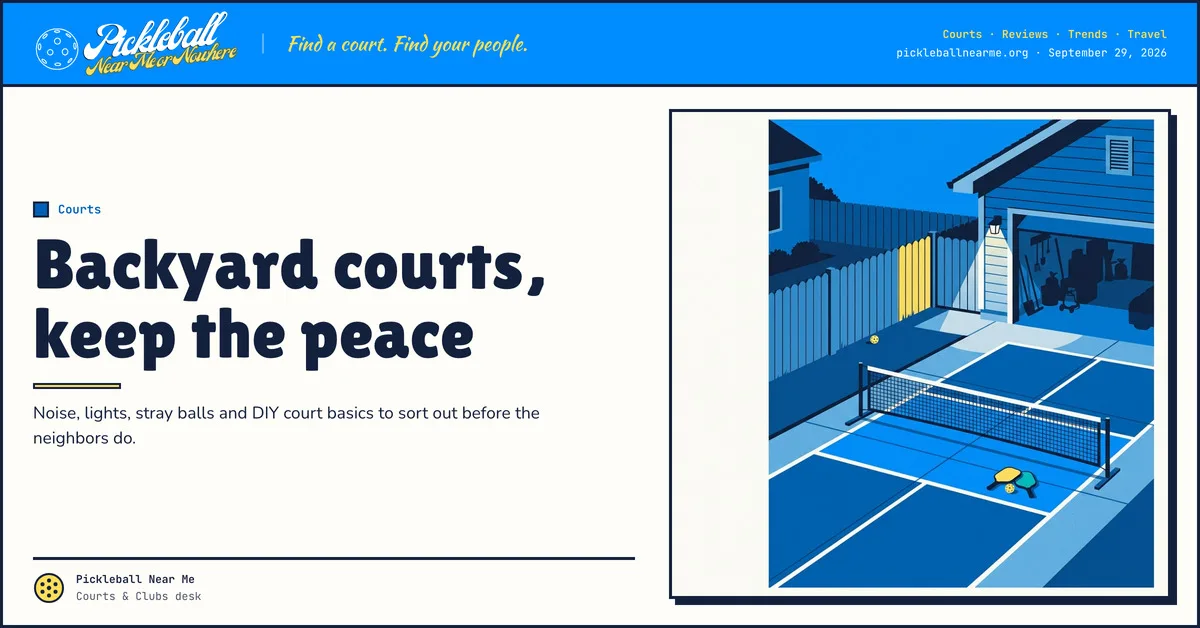
Editorial illustration; temporary driveway net at dusk, not a finished residential court.
Backyard pickleball is the search people type when they want a net on the driveway — and the search neighbors type when the dinks start late. Home play is convenient. It is also loud, lit, and close to someone else’s fence line. Treat noise and boundary manners as part of the court plan, not an afterthought.
A late-August Reddit thread about fence-climbing for stray balls, lights, and a $200 “tournament balls” bill pulled thousands of comments. Top replies zeroed in on permits, lighting, noise, and property values. This guide covers what backyard pickleball usually means, why neighbors push back, a setup checklist before you pour anything, and how DIY / cost searches fit without fake budgets.
What backyard pickleball usually means
Most “backyard pickleball” setups sit on a spectrum:
- Temporary net on a driveway or flat yard — lowest commitment; pack it up when guests arrive.
- Painted or taped residential lines — still temporary enough to reverse if the HOA or next door pushes back.
- A permanent residential pickleball court — surface work, fencing, maybe lights; this is where “how to build a pickleball court” and “diy pickleball court” searches live.
A pickleball court in a backyard does not have to be tournament-spec to start a neighbor fight. Hard surfaces reflect sound. Walls bounce it. Outdoor balls and late hours make the problem travel farther than the kitchen line.
If you only need casual hits after work, a portable net and painted driveway lines often beat a full build. Save permanent fencing and lights for after you know the lot works — and after the people next door have met the plan, not the surprise.
Why neighbors push back on pickleball noise
Search intent around pickleball noise, pickleball noise complaint, and even pickleball noise ordinance exists for a reason. Neighbors rarely object to one quiet midday dink session. They object to patterns: repeated fence climbs, evening lights, people entering a yard for balls, pets getting out, garden damage, and the fear that a noisy court next door will ding property values.
I would take this to the next level… File a complaint with the town. Seems like a nuisance. Check his permits… (e.g. lighting, noise…
u/mojosofla (645 upvotes), r/PickAorB, August 30, 2026
In the same thread, other highly upvoted replies reframed the conflict beyond stray balls. One commenter (u/Educational_Sink8355, 399 upvotes) said lights, people coming into the yard, a dog getting out, and garden damage made the whole setup feel like a broader nuisance. Another (u/humble-meercat, 250 upvotes) tied the fight to property values and “noisy dinks,” and pointed readers to the wider online noise fights already documenting how loud residential play can feel next door.
That thread is community sentiment, not a statute. It is useful as a preview of what shows up when a backyard court becomes a town complaint. Lights and sound travel. A “quiet” open play to the players can still read as a nuisance next door when the kitchen window faces your baseline.
For the national pattern of residential pushback as a growth side effect, see our Trends lane — then come back here for the practical checklist. This post is the home-court guide; it is not a rewrite of our North Jersey public-courts shortlist.
Backyard setup checklist before you escalate
Before you hang lights or call a concrete crew, run the neighbor filter. The goal is not to win a Reddit argument. It is to keep play going without becoming the house everyone Googles ordinances about.
| Check | Why it matters |
|---|---|
| Hours of play | Late lights drive complaints faster than midday dinks |
| Ball containment | Fence gaps lead to fence climbing, then conflict |
| Surface: temporary vs permanent | DIY and residential court intent — research local permits first |
| Noise path | Hard surfaces and walls reflect; ordinance searches exist for a reason |
| Neighbor heads-up | Soften conflict before the first open-play crew arrives |
Practical checklist, not legal advice. Framed from the August 30, 2026 r/PickAorB neighbor thread and OpenSEO intent around backyard, DIY, and noise terms (pull date 2026-09-28).
DIY and cost searches without fake budgets
What “pickleball court cost” and “diy pickleball court” usually mean
People searching pickleball court cost, how to build a pickleball court, and diy pickleball court want a sense of scope: surface prep, fencing, nets, lighting, drainage. We will not invent a national price sheet here. Costs swing with lot grade, climate, materials, labor, and whether you need permits or HOA approval.
Get local quotes. Call the permit office. Ask what a residential pickleball court means in your zoning — then decide. If a contractor pitches stadium-bright lights as a default add-on, ask what the beam does on the neighbor’s bedroom wall at 8 p.m. That question belongs in the same conversation as concrete thickness.
Residential pickleball court vs temporary net
A temporary net is reversible. A poured or permanent residential court is not. If you are still testing whether the lot works for hours, sound, and ball flight, stay temporary. If neighbors already flinch at a portable net, permanent lights will not fix the relationship. The trade-off is convenience versus flexibility when the HOA or the town starts asking questions.
Verdict
What PBN readers should do next
Try a temporary setup first. Stock outdoor balls you expect to lose over the fence. Agree on hours before the first group chat invite. Talk to neighbors before you pour. If home play still feels like a war path, use public courts instead of forcing a residential build — and keep an eye on how residential noise is showing up nationally on our Trends coverage.
Outdoor backyard sessions burn through balls. Amazon’s changing best-seller list is one browsing route, not a PBN product verdict.
If a backyard court is not workable, find public and club options on courts across North Jersey.
Hard driveway play is rough on footwear — when you move indoors, pick pickleball shoes for indoor season instead of running shoes.
Residential play is part of a wider boom — see the fastest-growing sport map and DUPR city list for context.
Amazon Prime
FREE DELIVERY · TV · EXCLUSIVE DEALSFree delivery, award-winning TV, exclusive deals, and more. Prime is only $14.99/month plus tax; cancel anytime.
Affiliate link · terms on AmazonBrowse JustPaddles
DRIVEWAY TO COURT · COMPARE · NEW RELEASESSorting backyard setup first? When you are ready for a paddle, compare current models without the hype.
Affiliate link · confirm model and current termsFAQ
Is backyard pickleball legal?
It depends on your town, zoning, HOA, and whether lighting or a permanent surface needs a permit. This page is not legal advice. Check local rules before you build.
Why do neighbors complain about backyard pickleball?
Common flashpoints are noise, lights, balls leaving the property, people entering yards, and worries about property values — the same themes that dominated the August 30, 2026 r/PickAorB thread cited above.
What should I check before building a residential pickleball court?
Hours of play, ball containment, temporary vs permanent surface, noise path, neighbor communication, and local permits. Treat cost and ordinance questions as local research, not one national answer.
Play at home if the lot and the relationship can take it. If they cannot, the neighborly move is a temporary net — or a reserved court somewhere else.
Amazon Prime
DELIVERY · MEMBER DEALS · STREAMINGBuying court essentials on Amazon? Compare Prime’s delivery, member deals, and entertainment benefits before choosing a plan.
Delivery benefits depend on the item and location. Check current fees and renewal terms on Amazon.
Affiliate link · we may earn a commission on eligible signups. Eligibility and membership terms apply. As an Amazon Associate I earn from qualifying purchases.