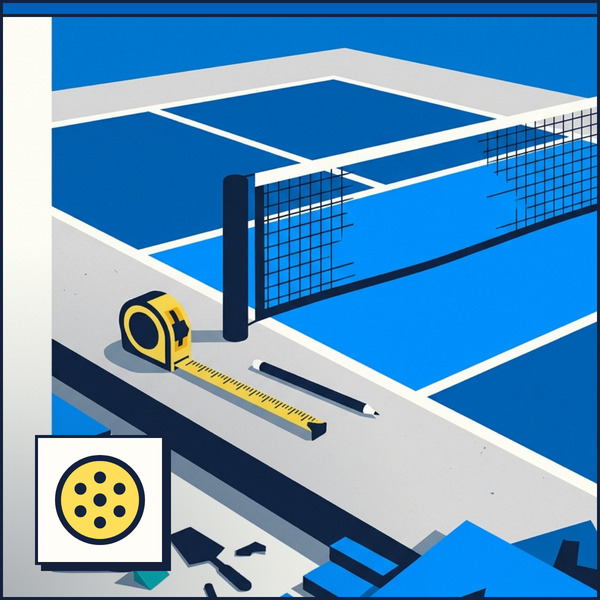
A pickleball court is 20 feet wide by 44 feet long for both singles and doubles. Those are the painted playing lines, not the whole surface you need to play safely. USA Pickleball’s court guide and its 2026 official rulebook agree on the playing rectangle.
If you’re measuring a backyard, mark the 20-by-44 court first, then account for room beyond the baselines and sidelines. The rulebook’s new-construction footprint is larger. Confusing the two numbers is how a court fits on paper but not in play.
The court is 20 by 44 feet. The yard has to hold the court and the players chasing a ball past its lines.
Official pickleball court size
The 2026 rulebook’s Section 3 defines the court and the lines. This is the quick measurement sheet. An indoor court has the same playing dimensions as an outdoor one; you don’t shorten it for singles. If you’re new to the sport, our pickleball basics explain how a point works without turning this measurement guide into another rules primer.
| What you’re measuring | Dimension | Where it comes from |
|---|---|---|
| Playing court, singles and doubles | 20 ft wide by 44 ft long | USA Pickleball, What Is Pickleball and 2026 rulebook Section 1 |
| Non-volley zone on each side | 7 ft deep by 20 ft wide | 2026 rulebook Rule 3.A.4.c |
| Net at the sidelines | 36 in high | 2026 rulebook Rule 3.B.6 |
| Net at center | 34 in high | 2026 rulebook Rule 3.B.7 |
| New-construction playing surface | 34 ft wide by 64 ft long | 2026 rulebook Section 3.A court specifications table |
The answer to “how big is a pickleball court?” depends on which rectangle you mean. The pickleball court dimensions in feet are 20 by 44 inside the sidelines and baselines. The larger new-construction figure belongs to the playing surface around those lines. Rule 3.A.2 says court measurements are taken to the outside edge of the perimeter and non-volley-zone lines; measure there, not to the middle of a painted stripe.
Backyard pickleball court dimensions
Start with a tape measure and two rectangles. The first is the regulation playing court. The second is the room available around it. For new construction, USA Pickleball’s 2026 rulebook lists 34 by 64 feet as the playing-surface footprint. Don’t silently turn that number into a guarantee that any particular backyard, fence, drainage plan or local permit will work.
The last 30 days of backyard-court conversation reinforced a useful distinction: players talk about the space outside the lines, not just the lines themselves. A recent builder reel argued that squeezed playing space is a common owner mistake, while a September backyard-court post described a much larger personal layout. Those are individual examples, not regulations or price benchmarks. The rulebook, rather than a social post, supplies the numbers in our table.
Walk the proposed footprint with the net line marked. Stand behind each proposed baseline and follow a ball that sails long. Look along the sidelines for fences, landscaping and anything else a player could meet while moving. If the space only accommodates the 20-by-44 lines, it is not the new-construction playing surface listed by USA Pickleball. A partial practice layout can still be useful, but call it that rather than promising a full regulation setup.
Check grade, drainage, setbacks and any HOA or municipal requirements before commissioning a slab. The USA Pickleball construction guide advises a north-south orientation outdoors so morning or late-afternoon sun does not shine straight into players’ eyes. It does not approve your lot. Get local advice on water and permission; neither can be inferred from a court diagram.
Already playing with a temporary setup? Read our portable net guide for the hardware and height checks. Our separate backyard noise and neighbors guide covers the conversation beyond the property line. This page is about layout, not a fresh claim that your town allows a court.
Lines, kitchen and net
The kitchen is not extra space outside the court. Under Rule 3.A.4.c, the non-volley zone runs 7 feet from the net on each side, between the sidelines. Its boundary lines belong to the zone. The centerline then runs from each kitchen line to its baseline, dividing the service courts. USA Pickleball says the court lines should be 2 inches wide and a single contrasting color (Rule 3.A.4.e).
Measure the net at two places: 36 inches at the sidelines and 34 inches at center. Rules 3.B.6 and 3.B.7 allow a quarter-inch tolerance. A casual pop-up setup may sag by the end of a session. If you’re marking a court for regular play, check the center after the net has been tensioned rather than assuming the box label gives you an accurate playing height.
CourtKit pre-measured court marking kit
PRE-MEASURED LINES · 20 × 44 FT · TEMPORARYLays out the 20-by-44 lines and kitchen without a tape-and-chalk session. Fine for a driveway or a test layout before you paint.
Affiliate link · confirm model, seller and current termsQuestions players ask
Is a singles pickleball court smaller?
No. USA Pickleball specifies the same 20-by-44-foot court for singles and doubles. The number of players changes; the perimeter does not.
Is 20 by 44 feet enough for a backyard court?
It fits the painted playing rectangle, but not the 2026 rulebook’s 34-by-64-foot new-construction playing surface. If your yard is tight, measure the usable area and ask a qualified court builder how a smaller practice setup would work. Do not label a cramped pad a regulation new build.
How deep is the pickleball kitchen?
Seven feet from the net on each side. Rule 3.A.4.c includes the bounding lines in the non-volley zone. That line matters when a player volleys near it.
Do indoor courts use different dimensions?
No. The same playing court dimensions apply indoors and outdoors. Indoor planning still needs usable space beyond the lines and a ceiling that does not interfere with play; this article does not prescribe a ceiling clearance.
Before you buy materials, draw both rectangles on your actual site. If the yard does not fit them, find a court to play on instead of squeezing the baselines against a fence. Our North Jersey courts guide is one starting point. A tape measure now is cheaper than discovering the missing runoff after the slab sets.