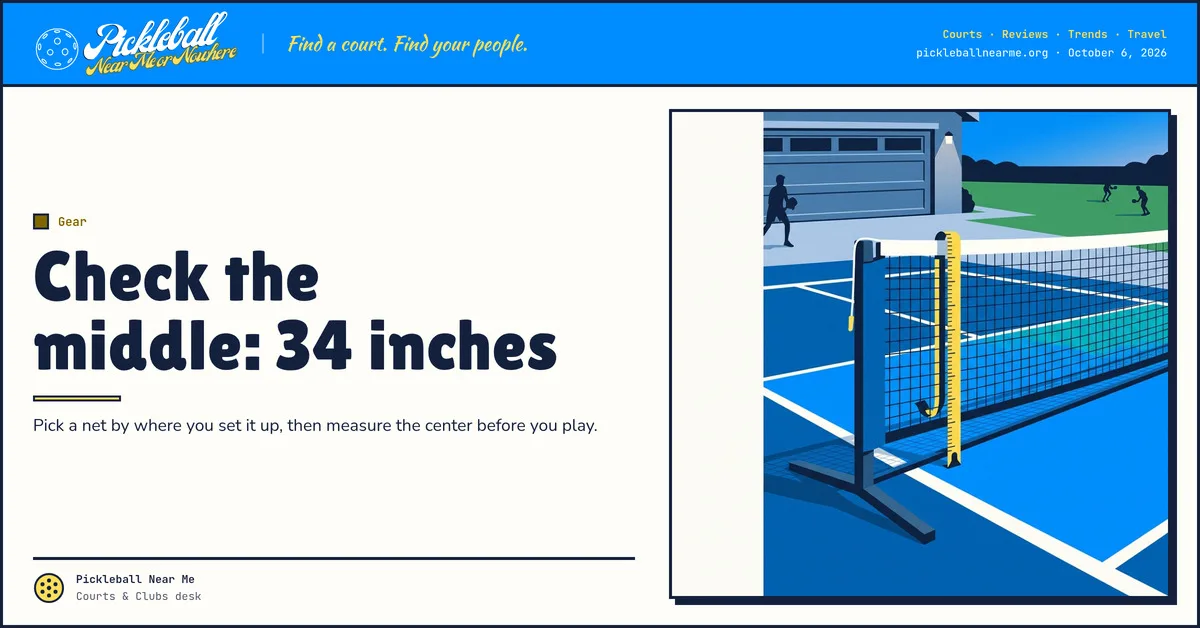
Editorial illustration; a portable net on a driveway at dusk with a tape measure hanging from the top of the net, not a specific product.
A portable pickleball net turns a driveway, an empty tennis court or a church gym into a court in a few minutes. Finding one is easy. Finding one that still sits at 34 inches in the middle after an hour of dinks, and that you’ll actually haul back out next Saturday, is harder. Backyard players are weighing temporary against permanent this fall, indoor season has rec centers pulling nets out of storage closets, and the noise fights haven’t gone anywhere. So skip the “best net” ranking. Pick by where you’ll set it up and how often it comes down, then run the tape-measure test.
Pickleball net height and dimensions: the tape-measure test
Here are the numbers that matter, from USA Pickleball’s 2026 Official Rulebook (rules 3.B.2 to 3.B.7). The net should be 36 inches high at the sidelines and 34 inches at the center, each within a quarter inch. The posts sit 22 feet apart, inside edge to inside edge, give or take an inch. The net itself is at least 21 ft 9 in long and 30 inches deep, with a 2-inch white tape binding over the top cord. A center strap is allowed, and if there is one, the 34-inch measurement includes it.
That gives you a three-step check for any net, new or borrowed:
- Measure both sidelines. You want 36 inches from the playing surface to the top of the tape.
- Measure dead center. You want 34 inches. A portable net that reads 35 or 36 in the middle is a net with no center tension.
- Measure again after 20 minutes of play. This is the one most buyers skip. If the center has crept down, the net is sagging, and it will keep sagging.
Sag is the classic cheap-net failure. Center height on a portable net comes from tension: a top cord, a boom or crossbar, and often a strap. FORWRD’s 2026 SwiftNet review puts it bluntly: standard portables rely on a center post or strap to hold 34 inches, and nets without one tend to sag. Pickleheads makes the same point from the other side, noting that velcro-strap systems can loosen over time. A net that passes step three is worth paying for. One that fails it will annoy you every session.
Match the net to your setup
Pickleball.com’s Sep 25 explainer sorts net systems into four groups: portable, roll-away, semi-permanent and in-ground. It boils the choice down to how often the net has to move, and how far. That’s the right question, so here’s PBN’s version of it, mapped to the four places people actually set up.
| Setup | What matters most | What to skip |
|---|---|---|
| Driveway | Wheels or a short carry from the garage, weighted feet for wind and slope, a center you can re-tension | Nets that need stakes. You can’t drive them into asphalt. |
| Backyard slab | Stability and tension over long sessions. A roll-away frame that can stay up for the weekend helps. | Bargain nets left out for weeks. Sun and rain wear the fabric, and FORWRD warns against leaving even premium portables assembled outdoors. |
| Gym floor | Non-marking feet, fast setup inside a booked time slot, a bag that fits the storage closet | Anything that needs sandbags or stakes, or needs a tool kit to break down |
| Park or travel | Roughly 20 lb or less, a one-person setup and a bag with a shoulder strap | A 40-lb wheeled system you’ll have to lift into a trunk every time |
The gym row has a bonus. A net is only half of a pop-up court; you also need lines. In a September r/Pickleball thread about marking temporary courts, players suggested chalk or tape, and one pointed out that a badminton court in the same gym already has the right footprint:
Any badminton courts/lines in those gyms ? Same dimensions except for kitchen line.
u/throwaway12345679x9, r/Pickleball, Sep 15, 2026
A badminton doubles court is 20 x 44 ft, so only the kitchen line needs tape. If you’re taking a net to a rec-center night, our indoor pickleball guide covers what else changes when you move inside.
Portable pickleball nets reviewers are recommending in 2026
PBN hasn’t tested these nets. This is a “who’s talking” table: the four models that keep showing up in 2026 coverage, with each claim credited to whoever made it. Pickleheads’ “Best portable pickleball nets (2026)” list (last updated October 2025) ranks the Srikel FlashCourt first for value. FORWRD’s June 2026 review covers the SwiftNet 2.1 and compares it with the PickleNet Deluxe.
| Net | Weight + wheels | Price cited | Who says what |
|---|---|---|---|
| Srikel FlashCourt | 26 lb, no wheels | $174 with Pickleheads’ code (about $200) | Pickleheads’ #1 overall. Accordion frame that pulls open, two-person setup in under a minute, and the reviewer says to weigh down the posts. |
| PickleNet Deluxe | 42 lb, wheels | $499.95 (FORWRD) | OnCourt OffCourt’s net. Pickleheads calls it the sturdiest in wind, and it rolls aside fully assembled. FORWRD calls it the Official Net of USA Pickleball and the better pick for facilities. |
| SwiftNet 2.1 | 17 lb with bag, no wheels | $369.99 at Pickleball Central (FORWRD) | No center post. A non-stretch top cord holds 34 inches, it sets up solo, and FORWRD says it takes about 3 minutes once you’ve practiced. Pickleheads timed a two-person setup at 1:47. |
| Fostoy net set | 17 lb, wheels | About $80 (Pickleheads) | Pickleheads’ pick under $100. Comes with a full 22-ft net and an 11-ft half-court net. Pickleheads says it isn’t built for long-term outdoor use. |
Read the table against your setup map. Driveway players who want something that stays up should look at the wheeled rows. If you carry a net to a park alone, the 17-lb SwiftNet is the one built for you. The Srikel is the value play if there’s a second person to help pull it open. Srikel’s own TikTok pitch (Sep 23) goes straight at the pain point: setup that takes longer than the game. Treat that as marketing, but it’s the right thing to measure.
Nets are long, heavy boxes, anywhere from 17 to 42 lb on the numbers above, and that’s where free delivery earns its keep.
Amazon Prime
FREE DELIVERY · TV · EXCLUSIVE DEALSFree delivery, award-winning TV, exclusive deals, and more. Prime is only $14.99/month plus tax; cancel anytime.
Affiliate link · terms on AmazonRegulation net vs half-court and practice nets
A lot of “pickleball set with net” listings are really practice kits. That’s fine for kids, for drilling, or for a rally in the yard. Just know what you’re getting. A half-court net like the 11-ft one in the Fostoy set is a training tool. It isn’t a regulation net, and it can’t give you a real 22-ft game. If you want a starter bundle with paddles and balls, see our older pickleball sets roundup and our beginner gear basics, then come back and buy the net separately if the bundled one fails the tape test.
Tennis courts are the other shortcut. Pickleheads notes that tennis nets stand 42 inches at the posts and 36 at the center. Even if you strap the middle down to 34, the sidelines play high. Lots of groups live with that at the park. For a home court, a regulation portable is the cleaner answer.
Portable net vs a permanent backyard court
A permanent court starts with space and concrete, not a net. A September r/PickleballAfterWork post did the math: USA Pickleball calls for at least 30 x 60 ft of total space and recommends 34 x 64 for a new court, well past the 20 x 44 lines. A portable net lets you play on the space you already have and find out how often you really play before you pour anything.
It’s also the cheapest peace treaty with the neighbors. In Methuen, Mass., a resident sued over the noise from nearby courts (WHDH, Sep 17). A judge denied a temporary injunction on Sep 23 (Eagle-Tribune, Sep 26), and the city pointed to its fixes: limited hours, sound barriers, and quiet paddles required at some courts. At home, a net that comes down in five minutes and goes back in the garage sends the same signal. Our backyard pickleball guide covers the rest of the neighbor checklist.
Verdict + who this isn’t for
Who this isn’t forTournament directors pricing permanent in-ground systems, and anyone who wants a lab teardown. This is a buying framework built on attributed reviews.
Portable pickleball net FAQ
How tall is a pickleball net?
USA Pickleball’s rulebook sets it at 36 inches at the sidelines and 34 inches at the center, each within a quarter inch, with posts 22 feet apart.
Are portable pickleball nets regulation?
Many are. Full-size portables like the four in our table are built to regulation dimensions. Check the listing for a 22-ft width, then measure the heights yourself, because a sagging center takes a regulation net out of spec.
Can I use a tennis net for pickleball?
You can play on one, but it stands 42 inches at the posts and 36 at the center, so even with the center strapped down to 34, the sidelines run high. It works for casual park games. A regulation portable is better for anything regular.
Measure twice, buy once. Then put the net up, play your games, and take it down before the neighbors start counting pocks. Need a paddle to go with it? Start with the best pickleball paddle lists of 2026.